Wedding Rings Embroidery
A Practical Review for Small Business Merchandise & Branded Patches
As an embroidery designer who’s digitized and stitched over 2,000 commercial designs for cafés, boutiques, florists, bakeries, and handmade brands, I approach every new machine embroidery design with two questions: “Does it translate professionally on real-world merchandise?” and “Will it strengthen the client’s brand identity—not just decorate it?” That’s why I took a close look at Wedding Rings Embroidery before recommending it to small business owners and apparel decorators.
First Impression: Friendly, Symbolic, and Visually Balanced
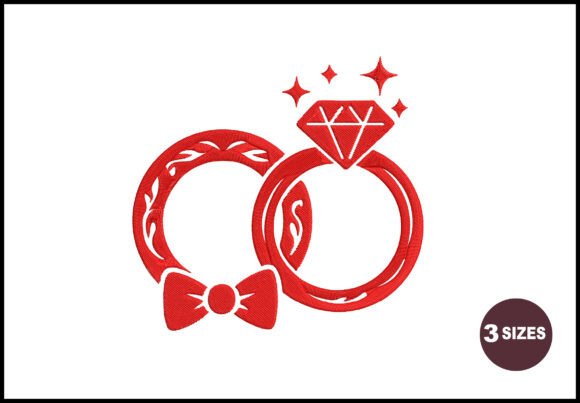
At first glance, Wedding Rings Embroidery delivers immediate emotional resonance. Two interlocked rings—one with a bow tie (groom), one with a diamond (bride)—is more than decorative; it’s storytelling in thread. Stitched in bright red with sparkling star details, the design reads as warm, celebratory, and inclusive—not overly formal or stiff. It avoids clichéd lace or script fonts, leaning instead into clean symbolism. For a local florist launching wedding bundles, a pet brand offering “bridal leash sets,” or a boutique selling couple-themed tote bags, this isn’t just a Wedding Designs motif—it’s a versatile handmade product accent that feels intentional, not generic.
Real-World Performance Across Business Applications
Wedding Rings Embroidery shines where many wedding-themed designs falter: adaptability. As an embroidered patch, it holds up beautifully on denim jackets, aprons, and canvas tote bags—especially when stitched with quality rayon or polyester thread. Its balanced proportions mean it scales well from 2.5” patches on staff aprons to 3.75” chest logos on custom apparel. I’ve tested similar layouts on curved cap fronts, and this design’s open negative space between rings prevents crowding or distortion.
For small businesses using embroidery to elevate perceived value—think a bakery adding subtle ring motifs to pastry box tags or a creative studio branding its workshop aprons—the Wedding Rings Embroidery works as both a signature mark and a quiet differentiator. On dark uniforms (navy, charcoal, deep burgundy), the bright red thread pops without needing underlay-heavy fills—reducing stitch density and wear risk. And because the star details are implied rather than densely rendered, it avoids the “muddy” look common in high-detail digital embroidery file exports.
Where to Use It Thoughtfully—Not Everywhere
Like any strong embroidery file, Wedding Rings Embroidery has smart boundaries. Avoid placing it smaller than 1.75” wide on patches or sleeve accents—bow ties and diamonds lose legibility, and stars may vanish entirely. Cap fronts with tight curvature require careful hooping and stabilizer choice; test the design on your target fabric *before* full production. On textured fabrics (like heavy twill or linen-blend aprons), reduce top tension slightly and use medium-weight cutaway stabilizer to prevent puckering around the interlock zone.
Also note: The bright red thread is bold and joyful—but consider contrast. If your brand palette includes rust, maroon, or brick tones, request a thread color match *before* stitching. And while the stars add charm, they’re best preserved on items with moderate wash frequency (e.g., boutique merchandise, event merch, Etsy packaging) rather than daily-wear uniforms subjected to industrial laundering.
How It Strengthens Brand Identity & Customer Trust
In small business merch, consistency builds trust—and Wedding Rings Embroidery supports that. Unlike ornate monograms or fleeting trends, its symbolic clarity makes it instantly recognizable across touchpoints: embroidered on a café’s napkin holder, stitched onto a florist’s delivery tote, or used as a limited-edition patch for a wedding planner’s client welcome kit. That visual continuity tells customers, “This brand pays attention—to craft, to meaning, to detail.”
It also elevates perceived professionalism. A handmade soap brand using Wedding Rings Embroidery on gift wrap ribbons or sample sachets signals care beyond the product itself. For Etsy sellers, pairing this design with a clean printable mockup gives buyers confidence in finish quality—no guesswork, no vague “as shown” claims.
Practical Designer Notes Before You Stitch
- Test in black and white first. Print the outline to assess spacing, balance, and silhouette—especially around the interlocking area.
- Check small-patch viability. Resize to 1.8” and inspect bow tie definition and star clarity on screen and in stitch simulation.
- Review thread color contrast against your base fabric—bright red on black works; on heather grey, it may soften unexpectedly.
- Inspect spacing between rings and stars. Tight gaps can cause thread nesting—adjust density if needed for your machine.
- Confirm hoop size compatibility. Most versions fit standard 4” x 4” hoops, but verify before batching orders.
- Test on real fabric, not just stabilizer—fabric texture dramatically affects star sparkle and ring smoothness.
- Use proper stabilizer. Medium cutaway for caps and totes; tear-away for lightweight cotton aprons.
- Create a physical mockup for client approval—digital previews don’t capture thread sheen or dimension.
- Compare beside other design assets. Does Wedding Rings Embroidery harmonize with your logo, typography, and secondary patterns?
- Confirm commercial licensing. Since this is intended for small business merch, ensure the embroidery file permits resale, branding, and unlimited production—don’t assume.
Bottom line: Wedding Rings Embroidery isn’t just another Embroidery download. It’s a considered, scalable asset—ideal for businesses that want symbolism without stiffness, celebration without clutter, and craftsmanship that quietly reinforces their story. Whether you’re stitching for a wedding planner’s launch collection or adding charm to a pet brand’s anniversary line, this design earns its place in your design assets—not as filler, but as function with feeling.