Service Dog Machine Embroidery Design
First Impression: Clear, Purpose-Driven, and Booth-Ready
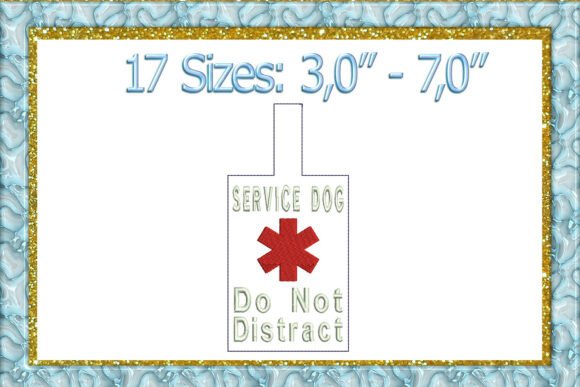
As an embroidery designer who’s prepped over 200 craft fair booths—and shipped thousands of embroidered tote bags, aprons, and patches—I opened Service Dog Machine Embroidery Design expecting utility first, charm second. What I found was exactly that: a clean, legible, no-nonsense design built for visibility and respect. It doesn’t try to be cute or cartoonish. It reads as confident, modern, and quietly authoritative—ideal for customers who value function without sacrificing handmade integrity. The phrase “Service Dog do not distract” anchors the composition with calm urgency, and the inclusion of “582” suggests this is a mature, field-tested design—not a rushed trend piece. That matters when you’re stitching 30+ items in two days before a market.
Where It Shines: Craft Fair Product Pairings
This machine embroidery design thrives where clarity meets everyday use. On a natural canvas tote bag? Perfect—centered above the pocket or scaled to 5.5”, it reads instantly from six feet away. As apron embroidery, placed just below the bib seam, it adds quiet professionalism to a baker’s or vet tech’s uniform. For tea towel embroidery, use the 4.25” size on the lower corner—it balances well against woven texture without overwhelming the fabric. And as an embroidered patch? Absolutely standout. The 3.46” x 7.00” dimension fits standard iron-on backing, holds crisp edges through washing, and gives enough real estate for both icon and text to land clearly.
It also works beautifully on structured items: cap fronts (use the 3.75”–4.00” sizes), small zippered pouches (3.00”–3.50”), and pillow covers (5.00”–6.00”, centered). Unlike ornate florals or dense monograms, Service Dog Machine Embroidery Design doesn’t compete with patterned fabrics—it complements them. That means less fabric-matching stress and more consistent booth cohesion.
What Makes It Sell on Etsy & at Markets
Etsy sellers and small shop owners need designs that convert fast. This one does. The phrase “do not distract” is emotionally resonant—it signals empathy, awareness, and shared values. Buyers don’t just purchase a logo; they buy alignment. In person, it draws thoughtful pauses—not just glances. At a craft fair, that pause turns into conversation, which turns into sale. It photographs exceptionally well: high contrast, strong horizontal rhythm, and balanced negative space mean your printable mockup or Instagram flat lay needs zero filters to pop.
And yes—it’s repeatable. With 19 sizes included (including the precise 3.46” x 7.00” / 87.8mm x 177.8mm spec), batch production is streamlined. No resizing guesswork. No pixelated scaling. Just load, hoop, and stitch—across cotton, linen, twill, and even medium-weight denim. That reliability builds trust in your finished product and protects your reputation as a detail-oriented maker.
Careful-Use Notes: Protect Your Stitch Quality
Don’t skip testing—even with a trusted digital embroidery file. Here’s what demands attention:
- Dense stitch areas: The lettering and border framing carry moderate stitch density. On textured towels or thick canvas, use cutaway stabilizer—not tear-away—to prevent puckering.
- Small lettering: Below 3.00”, the “do not distract” line risks softening. Stick to the 3.46” minimum for readable patches or caps.
- Curved surfaces: Caps and curved pouches require re-hooping finesse. Test the 3.75” size on a scrap cap first—check for letter distortion at the crown seam.
- Dark fabric: Thread contrast is critical. If using navy or charcoal, verify your white or light gray thread reads cleanly—no halo effect. A quick photo test under booth lighting saves returns.
Booth Impact & Brand Strength
In a sea of floral tea towels and whimsical pet motifs, Service Dog Machine Embroidery Design stands apart—not by shouting, but by standing still. It strengthens your booth’s visual authority. When grouped with complementary pieces (a service-dog-themed embroidered market bag beside a matching apron and set of tea towels), it tells a cohesive story: thoughtful, inclusive, and deeply human-centered. That consistency elevates perceived value—customers pay more for intentionality.
It also invites engagement. People ask questions. They share stories. That emotional resonance translates directly to higher average order value and repeat buyers—especially among educators, healthcare workers, and disability advocates who recognize authentic representation.
Pro Designer Checklist Before You Stitch
Before cutting your first fabric piece, run through this list:
- Test the embroidery file on scrap fabric *identical* to your production material—including same thread colors and stabilizer.
- Confirm hoop size compatibility—especially if using multi-position hoops or commercial machines.
- Inspect spacing between letters and icon. Tight kerning can blur at smaller sizes; adjust if needed.
- Check stitch count and density in your embroidery software—look for any nested fills or overlapping runs that could cause thread breaks.
- Create at least one real-world finished product: a stitched patch on a tote, a cap front, and a folded tea towel. Compare how each reads in daylight vs. indoor booth lighting.
- Review licensing: the description notes “582”—verify whether this machine embroidery design includes commercial use rights for resale of finished goods. Never assume.
Final Thought: A Quiet Powerhouse for Purpose-Driven Makers
Service Dog Machine Embroidery Design isn’t flashy—but it’s fiercely functional, deeply respectful, and commercially smart. It performs across categories, scales predictably, and connects authentically with buyers who value meaning over motif. For craft fair sellers, Etsy sellers, and boutique makers building a portfolio of intentional handmade product, this is more than a design asset—it’s a statement piece that sells itself. Just stitch it right, show it proudly, and let the message speak.